3 Local Vineyards to Visit: A Curated Guide
October 12, 2025
Gastronomy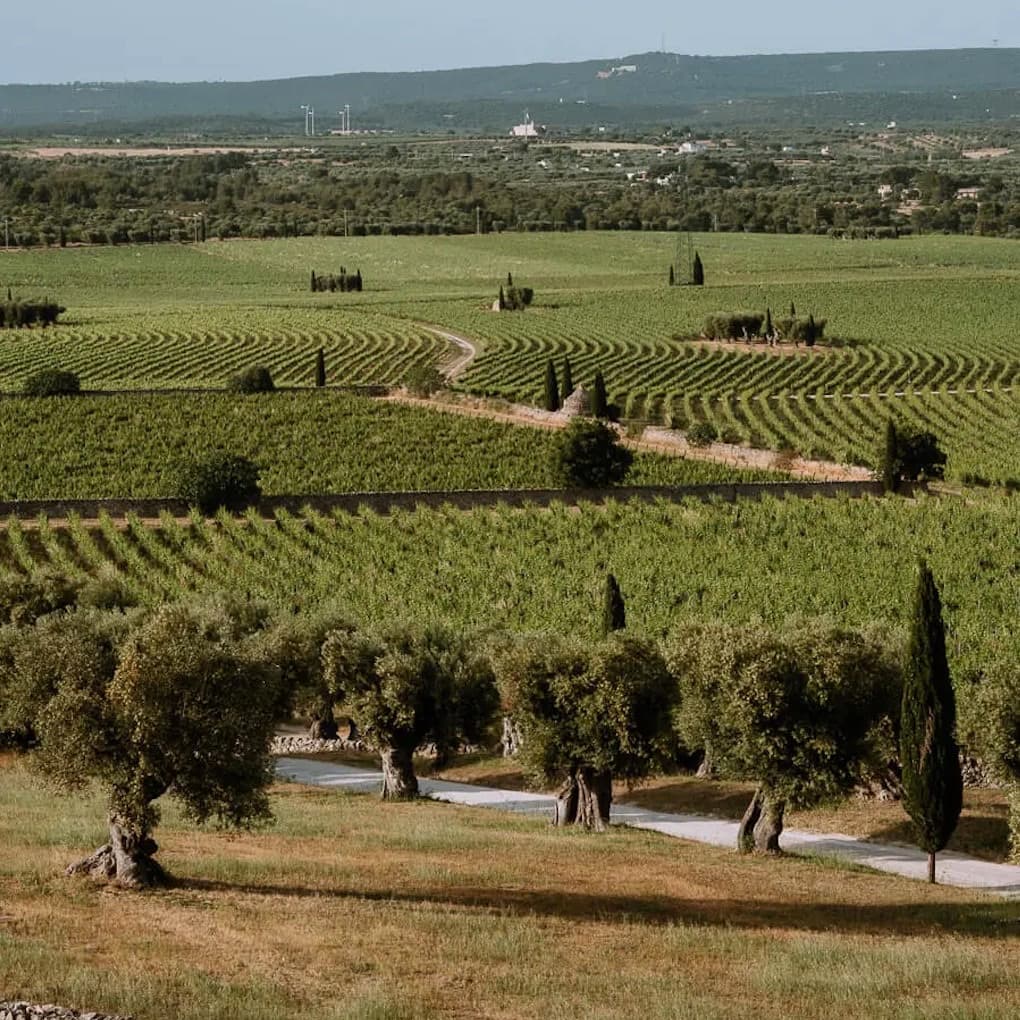
Three distinctive Salento wineries — each shaped by family, land, and history — offer an inspiring starting point for exploring the region beyond its beaches and baroque towns.
Wine in Salento is not just something poured into a glass. It is the quiet expression of land, climate, family, and time. Across this southern peninsula — where olive trees twist toward the sea and stone walls divide sun-washed fields — generations have worked vineyards with patience and conviction.
For those curious to explore beyond the beaches and baroque cities, a visit to a local winery offers a deeper understanding of the region. Each tells a different story. Each reflects a different way of listening to the land.
Here are three to consider as a starting point.
Cantele — Guagnano
The story of Cantele begins far from Salento, in Northern Italy, during a time marked by uncertainty. Giovanni Battista Cantele moved south after the war, gradually building relationships with local growers before founding the winery in 1979 with his sons, Augusto and Domenico.
From the beginning, Cantele blended northern technical precision with southern instinct. Augusto, trained in Conegliano, returned to Puglia with a belief that the region could produce refined, expressive wines — including whites — at a time when it was largely known for reds. Over time, the winery’s identity took shape through careful vineyard selection, thoughtful expansion, and an emphasis on clean, essential winemaking.
Today, the third generation continues that vision, balancing heritage with modern awareness — including sustainability and evolving market expectations. Visitors frequently remark on the professionalism of the tastings, the clarity of technical explanation, and the warm hospitality of the Cantele family and team. The iSensi tasting space is often described as minimalist and elegant, pairing wines with thoughtful food accompaniments that elevate the experience beyond a simple tasting.
**Cantele Winery** S.P. 365 (Salice Salentino – Sandonaci) Km 1 73010 Guagnano (LE), Italy Tel: +39 0832 705010 Email: cantele@cantele.it
Castel di Salve — Depressa di Tricase
Founded in 1885 by Antonio Winspeare, Duke of Salve, Castel di Salve is one of Salento’s historic wine houses. Remarkably, it was the first winery in the region to age and bottle its own wines — a pioneering step at the time. Early recognition followed, with awards in London, Chicago, Paris, and Naples before the turn of the twentieth century.
Today, the fourth and fifth generations of the Winspeare family continue to produce wines in the original cellar, opposite the family castle. Beneath the village streets, barracks rest in a limestone underground cellar where temperature and humidity remain naturally stable. Modernization has been introduced carefully, with solar energy powering much of the facility and a strong commitment to clean, controlled production.
The estate vineyards at Masseria Bosco Belvedere sit amid olives, oaks, cereals, and Mediterranean scrub, producing indigenous varieties such as Negroamaro, Malvasia Nera, Verdeca, and Primitivo. Reviews often mention the depth of storytelling during visits, the passion of family members involved in tastings, and the deliberate decision to keep production limited in order to preserve authenticity.
Many guests describe their visit here as a highlight of their time in Salento — not simply for the wines, but for the sense of continuity and character that defines the estate.
**Castel di Salve** Via Gaetano Salvemini, 32 73039 Depressa di Tricase (LE), Italy Tel: +39 0833 771041 Email: info@casteldisalve.com
Conti Zecca — Leverano
If Cantele represents thoughtful evolution and Castel di Salve reflects aristocratic history, Conti Zecca expresses something even older — a five-century relationship with the land around Leverano.
In the early 1900s, the family completed the full production cycle from vineyard to bottle, grounding their philosophy in respect for terroir. For them, wine is not simply the result of grapes and climate; it is the intersection of soil, biodiversity, microclimate, and human interpretation.
Their approach emphasizes minimal intervention, integrated farming practices, and plot-by-plot attention to vineyard conditions. Sustainability is not a slogan here but an ongoing responsibility — particularly in the face of climate change. Visitors often note the transparency of the production process, the visible bottling lines in action, and the balance between large-scale operation and care for top cuvées.
Hospitality is frequently praised in reviews, with bilingual guides offering detailed explanations of grape varieties, vinification methods, and the broader wine culture of Puglia. Tastings are generous, often accompanied by antipasti that highlight regional flavors.
**Conti Zecca** Via Cesarea sn 73045 Leverano (LE), Italy Tel: +39 0832 925613
A Starting Point, Not a Checklist
These three wineries differ in style, scale, and history. Yet they share a common thread: a deep respect for the land of Salento and a commitment to expressing it honestly.
There are many more vineyards across the region — some small and hidden, others well established — each offering its own interpretation of sun, soil, and sea air. The pleasure of exploring Salento’s wine country lies not in ticking off destinations, but in allowing time for conversation, curiosity, and discovery.
Begin somewhere. Ask questions. Taste slowly. And leave room to find the places that will become your own.